Poetry in the Schools

poetry-in-schools-cover-web
PDF of “Poems”

During the 1975-76 school year, university students in the creative writing program at the University of Arkansas taught elementary and secondary students across the state about poetry and various approaches to writing poems. The outreach program was known at Poetry in the Schools, or PITS for short.

From the writing, several poems from each school were chosen for publication, including more than a dozen written by seniors in the Class of 76. The attached PDF only contains the forward, introduction and poetry from FHS and the PitStop School in Fayetteville.

Today, the program is known as Writers in the Schools, or WITS, and continues to foster creative writing in schools across the state.
Study Hall

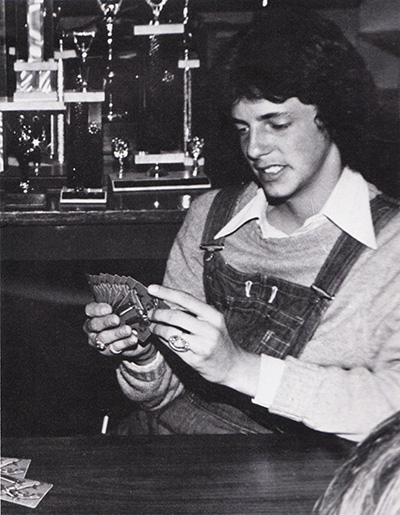
Jeff England's "cool" exterior hides a worried interior as he bluffs his way through a game of spades.
Jeff England’s “cool” exterior hides a worried interior as he bluffs his way through a game of spades.

Blah Busters

School getting you down? Tired of class after class after class of lectures? All students seemed to feel this way at one time or another, but after 12 years the seniors of ’76 came up with some exciting ways to “beat the blahs.”

For banjo picker Robert Meyer and guitar player Fred McClain, it was playing “Foggy Mountain Breakdown” in English study hall.

Hugh Painter, Phil Goff and Charlie Alison could be found around the school doing card tricks and magic.

“I like to practice magic. It’s loads of fun,” bubbled Phil.

A royal flush makes a big hand for the study hall clan who play poker. It's also a good hand when playing Spades or Hearts.
A royal flush makes a big hand for the study hall clan who play poker. It’s also a good hand when playing Spades or Hearts.

Other seniors relaxed by reading, talking, singing, drawing and playing cards. Terry Reed found enjoyment in “just being with friends.”

So next time a large group gets you depressed or you make a D on your algebra test, try some of the seniors’ ideas on bustin’ the blahs. After all, they had 12 years of practice.

— 1976 Amethyst

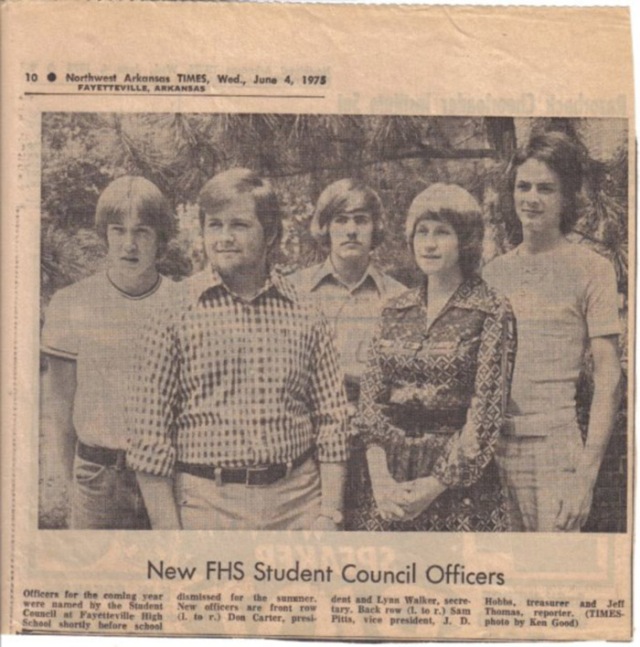
Student Council Officers

fhs-student-council-nwat-1975-web

Officers for the coming year were named by the Student Council at Fayetteville High School shortly before school dismissed for the summer. New officers are front row (l. to r.) Don Carter, president and Lynn Walker, secretary. Back row (l. to r.) Sam Pitts, vice president, J.D. Hobbs, treasurer and Jeff Thomas, reporter. (TIMESphoto by Ken Good)

— Courtesy of Jeff Hobbs

Parade Float

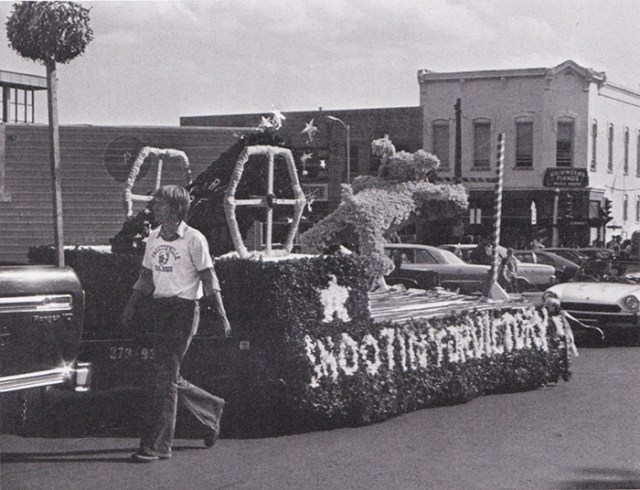
The Senior float, passing by Guisinger's Music shop on the Fayetteville square, shows a bulldog being catapulted out of a cannon toward a goal post with the theme: "Shootin' for a Victory."
The Senior float, passing by Guisinger’s Music shop on the Fayetteville square, shows a bulldog being catapulted out of a cannon toward a goal post with the theme: “Shootin’ for Victory.”

It’s About Time

For the first time since they entered FHS as sophomores, the class of ’76 won the Homecoming float contest. With class president John Horn as coordinator, seniors met for two weeks before Homecoming to decide on the float theme, “Shootin’ for Victory.”

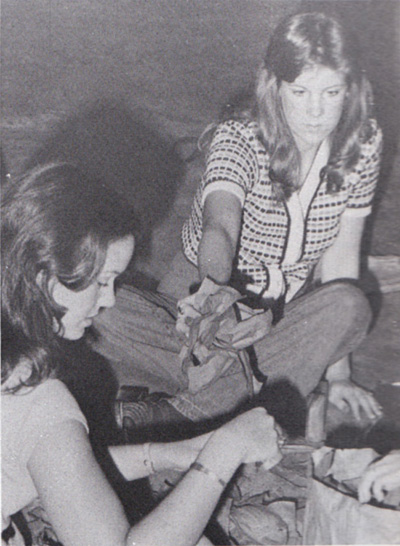
Pam Meinecke and Theresa Smith cut crepe paper for the senior float.

Jeff Thomas brought his stereo to the fairgrounds to entertain seniors as they cut crepe paper, built the frame and stuff the chicken wire.

Despite a shortage of crepe paper and time, the float was completed about 10 minutes before the deadline and ready to go for the parade the next day.

— 1976 Amethyst

Standardized Tests

Testing 1, 2, 3

Mike Brooks was one of many seniors who took the ACT, learning that it's harder to get into college than it is to stay there.
Mike Brooks was one of many seniors who took the ACT, learning that it’s harder to get into college than it is to stay there.

Testing 1, 2, 3, but it never stops there. The students were put through ever so many more. The were graded on their homework, given tests over it, and to top ita all off were given standardized tests to measure their ability to learn.

“Standardized tests, if used right by colleges, are a good thing,” said Susan Stephenson. “I don’t think the evaluation of the student should be based totally on the test, though. Academic records should be used, also.”

These tests were usually long and drawn out, last anywhere from all morning to all day. With the sophisticated forms that had to be filled out in order to apply for the tests, some people never got any further than applying for them.

“I don’t mind  taking the tests, but I don’t like the hassle of registering for them,” said Mark Springer.

But there was definitely a good side to all those tests. What better way was there to get out of school all day, legitimately?

National Merit semi-finalists are, from left, Karen Jones, Steve Yancey and Robert Meyer.

— 1976 Amethyst

Senior Privilege

campus-passes-web
It’s almost obvious from the faces that seniors enjoy senior privilege more than the teachers. Debbie Drake and Richard Steel wait anxiously as Mr. Hall ponders over their senior privilege slips.

Time Out

Senior Privilege made it through one more year at FHS. At the beginning of the year there was the usual doubt as to whether the seniors would be privileged again. “You better be extra good this year, or we’ll make you stay all day.”

Of course the seniors were all for getting it started as soon as possible. “I think it’s a good thing because people shouldn’t have to go to school when they have study halls,” said Cathy McRee.

Getting it started and keeping it running smoothly was the job of Vice-Principal Bill Brunner, but he still thought that “it’s good to give the students a chance to make other uses of their time, such as jobs or University classes.”

Even though everyone seemed eager for Senior Privilege to begin, there was a last minute rush to get teachers to sign permissions slips so the seniors wouldn’t have to go to their study halls the first day it started.

Some students felt that Tuesday and Thursday privileges weren’t enough.

“I think they ought to extend the privilege to every day of the week,” said Student Council president Don Carter.

Then there were those like J.D. Hobbs who “could care less” because “I already have all the privileges I need anyway.”

— 1976 Amethyst

International Students

exchange-combo-web
From left, Giovanni Crippa of Italy, Lotta Rüdh of Sweden and Marc Riviere of France were exchange students at the Fayetteville High School during the 1975-76 school year.

Near & Far

The new faces at FHS in 1976 that didn’t look like sophomores were the foreign exchange students, Lotta Rüdh, from Sweden; Marc Riviere, from France; and Giovanni Crippa, from Italy.

What did they think of FHS and the United States?

Marc and Lotta said that school was easier than in their own country but Giovanni said it was about the same. They all agreed that English wasn’t a problem since it had been a required class in their own school for more than seven years.

They were amused when they were asked about their favorite American food because, as they pointed out, most American foods are also found in their own country.

And what about American football? Lotta didn’t like it “because I don’t know what is going on.” Giovanni liked it only when they played well, but Marc preferred to watch the spectators.

They all agreed that the people here were as friendly or friendlier than in their own country, and they pointed out that it does take a lot of kindness to take foreign students and make them feel so welcome.

— 1976 Amethyst

Senior Class Officers

west-campus-class-officers-web
West Campus senior class officers, from left, James Vansandt, Debra Bell, Gary Fife, Linda Denny, Pat Bowerman and Kim Taylor.
east-campus-class-officers-web
East Campus senior class officers, from front, Shelley Faddis, John Horn and Jeff Thomas.

Top Dog

Although the purpose of class officers has never been too clearly defined and many people didn’t even know who their class officers were, one responsibility these leaders had was to organize their class float.

Elected during the fourth week of school, East Campus senior officers were John Horn, president; Jeff Thomas, vice-president; and Shelley Faddis, secretary-historian.

West Campus held their own elections again this year. The officers were Gary Fife, president; Debra Bell, vice-president; Linda Denny, secretary; Kim Taylor, treasurer; and James Vansandt, parliamentarian.

Shelley summed up the feelings of most of the officers when she said, “I feel it is a very honorable position. I am looking forward to serving my fellow students, especially since we’re seniors. I enjoyed working on the float because it was my last chance to work as a group with all my friends.”

—1976 Amethyst